Giants Castle Loop

Giants Castle Loop

This walk is doable for most people who has a moderate to high fitness level but we have done it with a group with no hiking experience, just remember the going on day two will be slow going up Bannerman Pass. Also take care going up Bannerman Pass in summer as thunderstorms can cause flash flood conditions in the pass as you have to walk up the stream bed for the last bit before topping out. In winter this pass can be choked with snow after a heavy snowfall and iced up for most of winter due to it not getting much sun in winter. So be prepared for all seasons.

The walk starts from the Giants Castle Main Camp and after completing the mountain register, make you way to the start of the walk that starts proper at the overnight car park situated at the pick nick area. After crossing the Bushman’s River you want to keep left and follow the Bannerman Hut trail that you would have seen from the start going up a ridge. This is the steepest part of the walk as it goes up the side of the spur until you reach the contour path. Take your time going up and remember to take water with you as there is not always a reliable stream till you get to the contour path. So fill up regularly when you find water.

At the contour path you will have a 4,5km easier walk to the hut that is built in the shadow of Bannerman Face and Pass. The last bit of uphill to the hut is not steep but does feel like it never ends. The hut is self is only a place to sleep and nothing of its former self. It use to have running water and even flushing toilet but due to vandalism and neglect it in fact is only a shelter from the elements. However it still have bunk beds and is warm and dry.

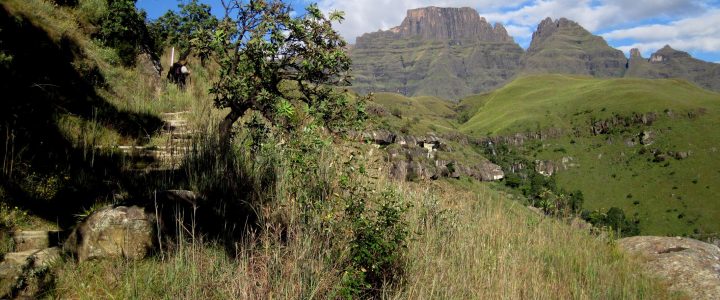
Day 2 starts with the easy approach to the pass and after crossing the stream and going over to the left hand side of the bank you start to climb steadily up and up into the pass. Spar Rib Cave is situated about half way up the pass, and is wet in summer with a number of drips making dry sleeping areas scares, in winter most of them have dried up and the rest usually freezes. From the cave level the path starts to cross over onto a rocky scree area where you can follow the cairns or pick you way through the rocks. Taking care not to twist an ankle here as the rocks are loose and very easy to roll into your leg.

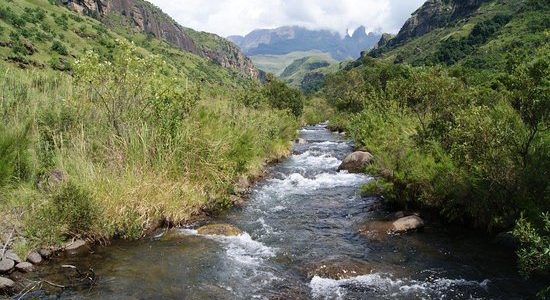
From here you will enter into the river and slowly start to make your way up the river. The rocks is convenient steps and you might have to use your hands and feet to scramble up certain section. Once over the steepest, the pass opens up and it tops out at a big cairn. Look back and appreciate the view. From the cairn consult your map and find the route that will lead you to the left of the pass and your climbing for the day is not finished yet as you have to climb out over the ridge and then pick your way over and then down to a suitable camp site close to water. On your map there is a small neck and you want to aim for this area so you compass and map is crucial instruments for this section especially in misty conditions. The camp site we usually use is about 500m from the top of Langalibalele Pass and close to the escarpment edge.

Day 3 is downhill, a killer on the knees for some people. Langalibalele Pass is steeped in history and Chief Langalibalele, who after his capture and trial, became the first political prisoner on Robben Island. There is a cross erected at the top by the Natal Carbineers in remembrance of the battle that took place here between them and the amaHlubi people.

The path down the pass is not as steep as others but badly eroded making going down difficult. You will have spectacular views over the Giants Castle valley below you as well as close up views of the peaks around you. The path crosses the stream and once you are on the other side of the valley you have done the pass and are now on the Langalibalele ridge, and considered by some the longest port of the hike as it feels like it’s never going to end. You will cross the contour path that runs from Bannerman Hut to Giants Hut, keep following the path down and on reaching the bottom there is a small stream crossing where you can swim and take a well-deserved rest. The path will take you down to Rock 75 and then back to Giants Castle camp where you can sign out from the mountain register and enjoy an ice cold coke or brew of your choice.

Spend a night in a Drakensberg Cave

Overnight in a Drakensberg Cave
Ifidi cave, one of the more elusive and special in the Drakensberg
The rolling sandstone cliffs of the Drakensberg mountains are eternally appealing to hikers and avid nature lovers, where Mother Earth can be embraced in all her fresh and dewy glory. And what better way to shake off the shackles of urbanity than by spending a night in a natural cave, just as our ancestors did hundreds of years ago?

What makes the Drakensberg so special?

The Drakensberg mountain range falls within the greater Maloti-Drakensberg World Heritage Site, one of the largest and most commercially inaccessible conservation areas in South Africa, filled with gorges, cliffs that rise towards the heavens, beautiful valleys, and, of course, numerous sandstone caves. Wildlife in the area includes rhino, wildebeest, and various grazers, while the impressive list of plant species features many rare and endemic species.

Hlalanathi, Northern Drakensberg

Prep properly for a night in a cave

There are literally scores of overnight caves to choose from in the Drakensberg, and they vary in size and views. While many must be booked in advance, some operate on a first come, first served basis, but these are generally smaller and further off the beaten track. To reach any of the caves requires a hike, and don’t expect any housekeeping services. Do, however, be equipped with all the necessary camping gear you will need for your stay, as well as enough food and water.

Hiker preparing to camp

It’s also a good idea to familiarize yourself with cave camping etiquette. Luckily, this list is not too complicated, with the bottom line being to leave nothing but your footprints behind. Campers are expected to remove all their litter, except that which is biodegradable and can be buried. Human waste should also be left well under the ground (note to pack a small shovel!) and the lighting of fires is prohibited. Besides the obvious danger of starting a bush blaze, fires smoke out caves and coat their walls with soot, making them uninhabitable for the many little creatures that live in their crevices.

San rock art in the Drakensberg

There are also many caves within the Drakensberg area that house ancient San rock art. Camping is forbidden in these.

You’ve got options

One of the most popular and easiest to reach overnight caves in the Drakensberg is Sherman’s Cave. The path begins just below the Cathedral Peak Hotel leading across the river and up the steep slopes towards a peak of the same name. Pass a lovely wooded gorge with a natural pool. Within about two hours you will have reached your overnight accommodation, where you can sleep like a baby, wrapped in the arms of the Earth. The deep cave has a low overhang that easily sleeps 10 hikers, as most of the floor is level. The roof is low, so be prepared to stoop, but the views of the surrounding mountain scenery are spectacular.

Sunset in the Drakensberg

Further hiking and accommodation information is available from Drakensberg Hikes, a comprehensive resource guide to all the caves in the Drakensberg.

Unexpected luxury under a rock

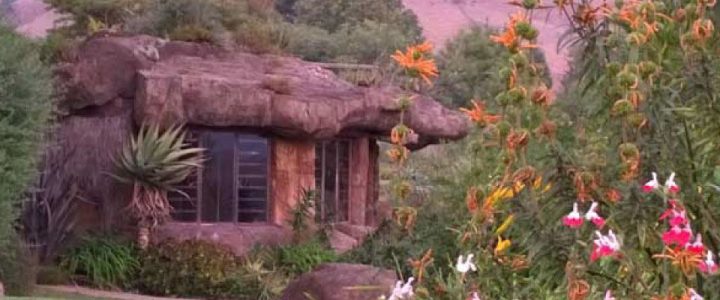
If you’re not the kind that can get comfy on a camping mattress, but still want to experience sleeping in a cave in luxury, then do consider Antbear Lodge, with a gorgeous accommodation unit built under a rock. Glass doors open onto a wooden deck with hammock chairs and a spectacular view of the Drakensberg mountains, while inside the cave is cozy and decadent, with a spa bath, a fireplace, and even rock art painted on its walls.

Antbear Lodge cave deck

The lodge supports sustainable and responsible tourism, with meals being made from organic ingredients and cooked from scratch. The artistic and inspiring furnishings were all handmade at the lodge itself. This is the ultimate in luxury caveman living, where you can spoil yourself with a private candle-lit dining experience, on the deck of your cave under the stars.

Antbear Lodge cave interior © Antbear Lodge

Antbear Lodge cave interior


Zulu Hut and Inkunzi Cave

Zulu Hut and Inkunzi Cave

Situated in the foothills of the Central Drakensberg mountains, in the beautiful Champagne Valley, are three totally unique self-catering units. Inkunzi Cave has a San theme, with rock art and carvings on the walls. The Zulu Hut has an African theme and is decorated in true Zulu style and Diddly Squat has a “squatter” theme!

Each of the three units has a braai facility and is completely private from the main house and other units. Roads are tarred all the way. The area boasts several places of interest, as well as shops, restaurants and loads of adventure activities. We are situated only 2.5 hours from Durban and 4 hours from Johannesburg.

The pools on the property are not fenced and as a result children who cannot swim are not accommodated.

Self Catering Accommodation

Inkunzi Cave (sleeps 4)
Inkunzi Cave has a rock finish inside and out, with rock art and carvings on the walls, ensuring a real “bushman” experience. It is fully equipped for self-catering, with a cooker, microwave, fridge, electric fireplace heater, DStv and sound system. The lounge / kitchen area has a double sleeper couch and separate toilet and “rock” shower, and the main bedroom has a toilet and amazing rock bath.

The large rock pool adjoins the cave which makes it unsuitable for families with toddlers or very young children. It sleeps 2 couples comfortably although it only has one separate bedroom. Uninterrupted views of the mountains and the surrounding hills are amazing.

The Zulu Hut (sleeps 4)
The Zulu Hut is like a traditional ‘mud’ hut, but the additional bathroom and large double shower are done in a unique rock finish. It has a cooker,fridge, TV, microwave and electric fireplace heater. Lie on the bed in the separate bedroom and watch the mountain change to a champagne colour as the sun rises.

There is a double sleeper couch, as well as a suspended single bed, in the lounge / kitchen area. This is ideal for families with children. There is a lovely little splash pool outside the hut.

Diddly Squat (sleeps 2)
Our third unit, Diddly Squat, is ideal for couples wanting to experience something really different. It has a double bed in a bed-sit style single room, with shower and toilet. The most exciting feature is the old wood stove for cooking, although there is also a 2-plate gas cooker and a large fridge.

There’s no TV so bring along your laptop with lots of movies. As you lie in bed, or sit in the ‘kitchen’, you’ll be able to see Champagne Castle and Cathkin Peak perfectly through the window. There’s also a small splash pool outside where you can cool down after your hike up the mountain! Enjoy a ‘budget’ style stay at real budget prices.

Lammergeier Hide at Giants Castle

Lammergeier Hide at Giants Castle

The Lammergeyer Hide is located in the Giants Castle reserve of the Drakensberg.

The famous Lammergeyer Hide is located in the Giants Castle Nature reserve of the Drakensberg. Lammergeyer is the other name given to the Bearded Vulture, and endangered Bird of Prey found in the Drakensberg area of South Africa.

The bearded vulture or Lammergeyer is most famous for its method of dropping bones from a height and once broken these vutures eat the marrow inside. The bearded vulture is one of the shyest of vultures, and lives a mostly solitary existence, on remote mountains and cliff faces.

The vulture hide ‘feeding season’ is May to September, and bookings open in the previous November. Tel 036-3533718, fax 036-3533775. Access is by 4×4 vehicle, provided by yourself or by the reserve. Alternatively, enquire about professional guides who will take you there or accompany you.

“A REAL bucket list venue for photographers and bird lovers. We recently booked and spent the day at this fantastic site. Although the hide is relatively small it was very comfortable for the 4 of us – 3 photographers and myself. The photographs from that day are exceptionally good – can’t imagine having better opportunities anywhere. If you love birds and photography this venue is a must! There is even a flush loo next to the hide. We had a day that we will all remember for the rest of our lives.” – Sandy from Hoedspruit

Caracal Cave

Caracal Cave

Highmoor is most probably one of the most underutilized hiking areas in the Drakensberg, but being able to drive just about all the way up the Little Berg makes it ideal for beginner hikers. The area is also the breeding ground for the Wattled Crain and well worth a visit for the avid bird watcher.

The trail follows an easy and well defined path from the Highmoor Camp Office passed the 3 high altitude trout dams. The climb is actually very mild and suitable for even the most unfit hiker. Once you have reached Windy Knoll, you can have a break to take in the spectacular view over the Little Berg all the way to the Giant. There are very few places where you can get so close and still enjoy the view.

An old folks tale tells us that when you point directly to the Giant, you will provoke the weather gods and this will lead to bad weather on your trip so be sure to make a point of not pointing directly at the Giant.

From Windy Knoll follow the path straight down to the bottom where you will be almost directly over the cave, to reach the cave carry on with the path to where it enters a rocky gully. Be careful here as it’s the most technical section on the trip, however it’s not too technical that you will need extra skills. This section is also very slippery when wet so take care with younger people.

After traversing back you will walk straight into the cave. The cave itself is actually a huge sandstone overhang with a smallish flat sleeping area that can sleep a group of 12 comfortably. Care needs to be taken with smaller children as the lip in front of the cave is steep and anyone falling here could be injured. In the rainy season there is a small waterfall falling over the lip of the cave that serves as a water source as well as a shower. In winter however, it usually dries up and the closest water is the small stream below the cave. On very dry years you might have to walk a bit further to get water.

The view directly from the cave is not that great, but if you walk back out to the steep section, you will be rewarded with a sunset to die for. Feel free to explore as far as you wish, make sure you tell the rest of the group where you are going and make sure you have a pre-agreed return time.

Please make sure that you follow the proper cave etiquette in regards to where and how to go to the toilet. No fires are allowed in any cave and you need to remove any litter from the cave, taking it back with you and dispose of it properly into a bin. By following these simple guidelines, you not only limit your impact on the environment but you also leave it pristine for the next group to enjoy.

Butterflies in the Drakensberg Mountains

Butterflies in the Drakensberg Mountains

The Drakensberg and Natal Midlands are butterfly hotspots. In the Drakensberg, look out for small butterflies around midday. Because conditions are usually windy, they often fly low and find shelter in the grass. Larger, more conspicuous butterflies are found in the gardens of resorts. The best butterfly season is between November and June.

Leopards Lair Lodge near to Giants Castle offers butterfly tours. Like the beautiful and serene butterfly, our butterfly tour seeks to introduce visitors to the lush and peaceful Midlands countryside and Drakensberg foothills. Their butterfly tours are led by a local guide who is keen to share his extensive knowledge about local rarities like the Midlands Widow, Estcourt Blue, The King Blue and the Mooi River Opal which are endemic and only found within a few km radius. We also talk about our local communities, its people, and traditions. Visitors will have the opportunity to encounter and experience farm life at a comfortable pace, away from the usual tourist hotspots.

A common butterfly at the Drakensberg is the Garden Acraea. It is small, mostly dull orange with a few black spots, and with conspicuously transparent fore-wings. It flutters weakly around its favourite plant, Kiggelaria africana (Wild Peach tree). This is where it lays its eggs, so the caterpillars have the right food. Nearly every plant-eating insect specialises on the single species that it can digest (all plants produce defensive chemicals to keep the ravening hordes at bay). Acraea caterpillars are small, black and hairy, and are the main food of cuckoos. The caterpillars hatch in such numbers that they can eat every leaf on the tree. With no food left they must pupate. Now the tree grows a new set of leaves, recovering completely.

Giant’s Castle Pass

Giant’s Castle Pass

Some say Giants Castle Pass  is an extreme 4 hr (6 km) hike from Giant’s Hut below the Giants Castle Pass while it is perhaps realistically a 3 hr moderately difficult hike although if you are carrying a full backpack you might find it quite punishing.

There are many ways to get to the bottom of this pass, the most direct being the Giant’s Ridge which leaves the Bushman’s River just past the Main Caves and joins the contour path 2km south of the base of Giant’s Castle Pass. The total distance to the bottom is 11 km.

Just before reaching the river coming down from Giant’s Castle Pass when approaching along the contour path from the south, a cairn marks a very vague path up to the left. This path gets even more faint but with care, it can be followed all the way to the boulder bed where the path becomes pretty clear. The initial path stays on the southern slopes, climbing quite steeply until it levels off and contours to the boulder bed in the throat of the pass. Cross the river and follow the cairns through the boulder section until a clear path is reached higher up. This path is very loose due to all the gravel and it is easy to follow it’s steep gradient all the way to the short final gully which takes you to the top at 3000 m.

Bannerman Hut and Bannerman Pass Circular Route

Bannerman Hut and Bannerman Pass Circular Route

 Day 1: A 10 km hike, mostly uphill to the best overnight hut in the Drakensberg. The hike starts at the day picnic spot at Giants Castle. A short downhill and then a mostly gentle climb for about 4km’s. The last 5km’s are along the contours to the Hut, enjoy the views on the way. The sunrise that awaits you from the hut in the morning is spectacular. Most people will be fine.

Day 2: Sleep in relative luxury and in the morning hike up Bannerman Pass. You have plenty time to get to the top and back before sunset for your second night at Bannerman Hut, take it slow and enjoy every second.

Day3:  return via Langalibalele Ridge, mostly downhill, the views all the way down will have you in awe.

Zulu Cave

Zulu Cave

Zulu Cave is situated on a cul-de-sac and fell out of use for a number of years, but being only one of a few caves that can be used for overnight trips it’s worth a visit. The route follows the main path from the Monks Cowl forest station up to the Sphinx and then on to Breakfast Stream. From here you follow the path that slowly takes you closer to the mighty peaks towering over the area and joining the contour path at Blindman’s Corner. Turning left will take you to Injasuthi, but we want to turn right and follow the path all the way to Hlathikulu Neck. Some of the peaks that will tower over you will be Cathkin Peak, Sterkhorn, The Tower and the Amphlett. At the Neck follow the path that leads to Keith Bush Camp, and before you turn off to the left, you will find a feint path that leads off to your right while the main path goes down. The path leads down the spur and you might lose it in places but  follow it down the spur keeping a lookout for the proper path. Your aim is to follow the spur to where the two streams meet and after crossing the eMhlawazini River, stick to the left hand side of the stream and follow the path that will first cross a bigger stream and later a smaller stream before crossing a bulbous spur. Once around the spur, it turns up into the valley and you don’t actually see the cave until you actually walk into it. The trees in front of it, not only hides it but gives it protection from the wind and rain. The cave can sleep 12 people with comfort and the waterfall is a source of water as well as a good swimming spot in summer. Unfortunately you don’t have a view of the peaks from the cave, but depending on the time of the day you can explore the valley below the cave as far as you dare to.

Injisuthi Camp

Injisuthi Camp

Injisuthi lies in the central part of the Maloti-Drakensberg Park World Heritage Site and is a four-hour drive from Durban and six hours from Johannesburg on the N3.

Cradled between the Injisuthi and Cowl Fork Rivers at the head of the Injisuthi Valley, the resort is surrounded by spectacular scenery dominated by Cathkin Peak, Monks Cowl and Champagne Valley.

The Mdedelo Wilderness Area immediately north of the resort is a unique, wild and remote mountain wilderness without any direct human impact.

This spectacular mountain landscape contains many rock shelters containing the largest and most concentrated group of San rock art in Africa south of the Sahara. These paintings were created by the San people over a period of at least 4 000 years and are of outstanding quality. The paintings depict aspects of the everyday and spiritual life of these vanished people.

Battle Caves, with its wide sandstone overhang, is one of the best-preserved San rock art sites in southern Africa. Guided walks are available to the cave daily (advance bookings essential). Injisuthi is the starting point of several extensive hiking trails leading across the mountains northwards to Cathedral Peak and south to Giant’s Castle.

Guided Walk


  • Guided walks to the Battle Cave, famous for its San Rock art, are booked in advance and are limited to a minimum of four and a maximum of 20 people.
  • Please contact +27 (0)73 353 1459, email: umhafatours@gmail.com or or +27 (0)82 216 9974, email: buffaloguides@lantic.net


Hiking


  • Overnight hiking routes extend deep into valleys and forests of the area and up onto the main escarpment, ensuring a pure wilderness experience with breath taking views and scenery.
  • Day hikes and walks consist of routes that are graded from easy to difficult. Some of them have gloriously refreshing rock pools to swim in leaving you feeling completely rejuvenated.
  • The weather can change suddenly and become very cold so hikers are advised to be well equipped. It is strongly recommended to hike in parties of four or more.
  • Please note: The Mountain Rescue Register must to be completed before you begin your hike. Make sure you sign out again when you return. Ensure that you complete the Mountain Rescue Register correctly and in detail. It is very often the only information the rescue team has to go on if you have an accident or get lost. When you leave the park, it is essential that you record your return in the Mountain Rescue Register. Failure to do so wastes valuable time for managers during rescue operations. Your life may depend on this information.


Trout Fishing


  • There are several kilometres of trout waters for fishing.
  • Trout anglers are required to pay a daily rod fee, which can be paid at the reception office.
  • Please note that only recognised trout fishing tackle and techniques are permitted.
  • Fishing is available all year round.


Caves


  • There are five caves, which are ideal overnight stops for hikers.0
  • Cooking may only be done on portable stoves whilst in the wilderness area.
  • Advance bookings must be made via the central Reservations office +27 (0) 33 845 1000
  • The Lower Injisuthi Cave – Maximum of 12 people, + 6 hrs/12km
  • Upper Injisuthi,Cave – Maximum of 10 people, + 8 hrs/15km
  • Grindstone Cave – Maximum of 10 people, + 3 hrs/5km
  • Marble Baths Cave – Maximum of 10 people, + 5 hrs/10km
  • Wonder Valley Cave – Maximum of 12 people, + 5 hrs/10km


Giants Castle Camp

Giants Castle Camp

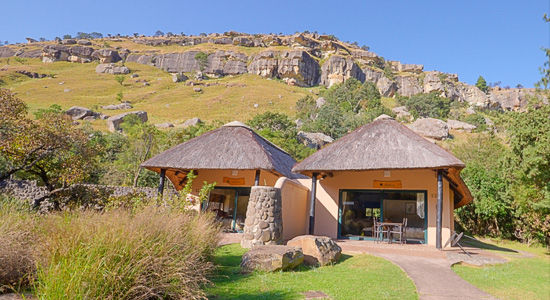
Giants Castle Game Reserve is home to the mighty eland as well as the rare bearded vulture and is situated within the Central Drakensberg region of the Ukhahlamba Drakensberg Park World Heritage Site. Giants Castle camp is positioned on a plateau overlooking the deep valleys running down from the face of the High Drakensberg. Giants Castle provides fantastic views for walkers, ramblers, hikers and enthusiastic mountain climbers. Giants Castle’s superb rock art is one of its many unique attractions. The popular vulture restaurant is open during winter for anyone wishing to observe the rare bearded vulture and other endangered species feeding. A visit to the Main Caves Museum at Giants Castle for an intriguing view of the past way of life of the San people is highly recommended.

Giants Castle Nature Reserve

Giants Castle Nature Reserve

Home of the eland and the majestic bearded vulture, lies in the Central Berg region of the Ukhahlamba Drakensberg Park, which is now a World Heritage Site. Giant’s Castle camp is situated on a gassy plateau among the deep valleys running down from the face of the High Drakensberg, offering glorious views for hikers and mountain climbers. The area is steeped in history, and superb rock art is high among its special attractions. The renowned vulture restaurant is open in winter for visitors to watch bearded vultures and other endangered species feeding. Guests longing for more insight into the Giants Castle history can visit the Main Caves Museum for fascinating insights into the past lifestyle of the San people.

At Giants Castle Nature Reserve, there is a large sandstone cave containing prehistoric San rock art. This cave is one of the biggest and best preserved painted sites in southern Africa. This cave is an easy 30 minute walk from the camp office and regular guided tours are taken through this unique exhibition from 09h00 to 15h00 daily for a small fee. A visit to Giant’s Castle offers the privilege of entering the world of the San as well as the opportunity to study a varied and exciting range of habitats. The San Art Museum (“Main Cave”) is a gentle 30 minute walk from the main camp while the grasslands, marshy areas (vleis), indigenous forests and many other energy flow ecosystems are easily accessible.

Game populations in the Ukhahlamba Drakensberg Park are kept at a level that can be sustained by winter grazing because with neighboring farms and fences, the wildlife is no longer able to migrate into lower more plentiful lands. As part of the grassland management program, large areas of the park are burnt annually to improve and maintain quality grasslands. Eland antelope and chacma baboons are commonly seen. Mountain Reedbuck and the rare caracal are occasionally spotted. There is a “Vulture Restaurant” where one may watch the Bearded Vulture [Lammergeyer] as well as other raptors.